
The Day My Life Changed Forever ~ 2026-06-01
Narrated video version of this blog can be found here.
~
Transformative life experiences often come in two different flavors; ones that are the culmination of years of preparation, and others by happenstance.
Take hockey player Jack Hughes, who scored the overtime goal that won the United States Men’s Hockey Team Gold at the 2026 Winter Olympics. Years of training, preparation, pitfalls, and triumphs culminated to that now historic moment that’ll live forever. While Hughes is still in the front half of his professional hockey career, it is likely safe to say that play will be the one that defines it.
On the other hand are the happenstance transformative experiences. Some of which are right place, wrong time, like Chesley Sullenberger III. He piloted the ill-fated US Airways Flight 1549 on January 15th, 2009. The right pilot in a worst-case scenario, losing both engines at 2,800 feet over the largest city in the country, performed a perfect water landing that saved all 155 souls on board. And of course, for some, there are wrong place, wrong time transformative experiences. Jon Krakauer comes to mind, the writer and mountaineer who survived the 1996 Mount Everest disaster. Krakauer’s book Into Thin Air turned him into a house-hold name in nonfiction writing while the event simultaneously consumed his mental health and personal life in the aftermath.
All of these experiences were life altering in their own ways. So many people have events like these that are so monumental in their own life narrative that it alters their entire trajectory.
My transformative experience was on June 1st, 2011.
The Greater Springfield EF3 Tornado.
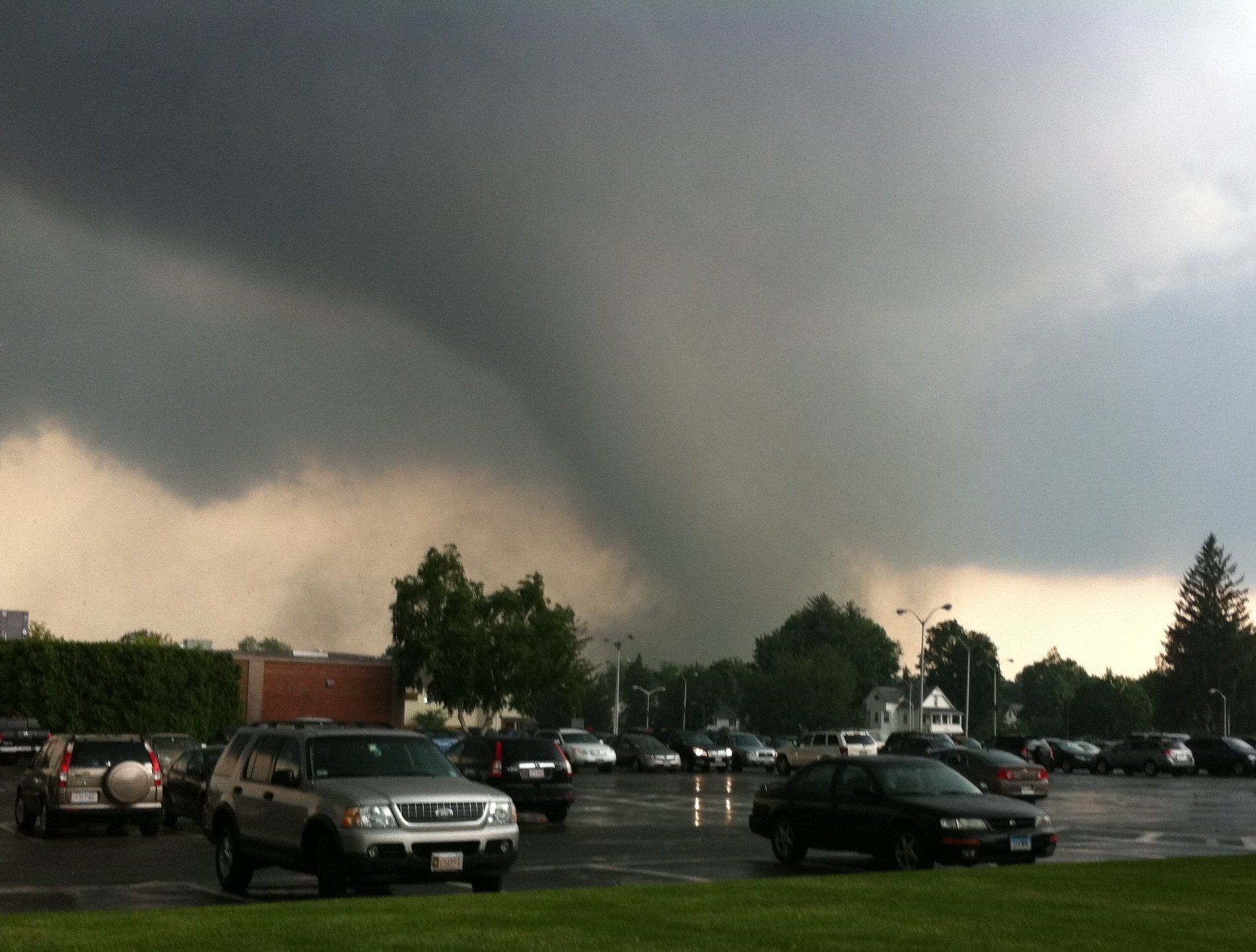
The EF3 tornado entering Springfield’s South End neighborhood. Photo by Mike Putzel.
What I remember of that event starts the week prior. May 22nd was my brother’s 10th birthday, and we had a small party for him on the back deck of our family home in West Springfield, Massachusetts. The main room connected to the back deck was the family room, which contained the main TV of our household. It was routinely on channels like Discovery, History, and of course, The Weather Channel. Even at middle school age, I was fairly dialed-in with active severe weather, especially in the wake of the Super Outbreak which took place the month prior. I knew there was a potential for a tornado outbreak across the Midwest, and with no Boston Bruins playoff game that night, the Weather Channel occupied the screen in the family room as we enjoyed birthday cake and presents on the deck.
Through the sliding screen door, I heard the familiar voice of Mike Bettes, who sounded particularly on-edge. As I left the deck, entering the family room, I looked to the TV to see a live shot of complete devastation and an emotional Mike Bettes. For a tornado nerd, this was like watching the broadcast of the Kennedy assassination. At that moment, Mike Bettes was my Walter Cronkite, narrating the immediate aftermath of the Joplin EF5 tornado, the most impactful tornado of the 21st Century. In my mind, 2011 was simply the year for tornadoes.
Fast forward to Wednesday, June 1st, 2011. I don’t remember much of school day other than being excited for Game 1 of the Stanley Cup Finals, which was slated for that evening. My beloved Bruins were taking on the Vancouver Canucks. I was semi-aware there was a risk for severe weather that evening, but that happens often between Memorial Day and Labor Day in New England. Most of these severe weather events are cold front-driven Quasi-Linear Convective Systems (QLCS). Damaging winds are the most common form of severe weather threat up this way in summer. Severe wind gusts are often responsible for bringing down our bountiful trees onto roads, power lines, and even homes. Tornadoes happen now and again, but are often short-lived and weak comparative to their central or southern US counterparts.
That afternoon I had a little league baseball game on the southern end of town at Memorial field, adjacent to the elementary school bearing the same name. I put on my uniform, grabbed my baseball bag, and hopped into the passenger seat of my mom’s 2003 Ford Windstar. Normally, we'd take a route through town to get to that particular field. However, we left earlier than usual to make a quick errand stop at the Riverdale Shops along US Route 5, a main artery that paralleled the Connecticut River. It was clear to me that a storm was coming, as I could see a massive cumulonimbus cloud to the north. Rain followed as my mom ran into the store. I waited in the car when my LG Xenox started to ring. It was my dad, who was working an overtime shift for the Holyoke Police Department, the city just north of my native West Springfield. He called to let me know there was a tornado warning for northern Holyoke and Northampton. Quite honestly, the way I remember it, this wasn’t as much of a call for me to seek safety, but rather just to let his weather-obsessed son know what was going on. This was still during a time when tornado warnings were not emergency alerts that pushed through automatically onto cell phones. Little did I know I’d be under my own tornado warning shortly thereafter.
Upon my mom completing the errand, we dropped south on Route 5. The blinding rain and small hail subsided as we headed south. In my mind, with a tornado warning nearby and the field probably drenched, the game would be canceled regardless. Even so, no call had come from the coach yet, so we pressed on towards the field.
Route 5 drops into a tunnel beneath the North End Bridge Rotary. Shortly before the drop into the tunnel is the exit to Park Street, where I watched the lowering of the clouds overhead. It was very dark and agitated with motion I had never seen before in typical New England thunderstorms. Further catching my eye was an object in the sky that I sensed was out of place. As I fixated on the object, it became clear whatever it was came from the ground. To this day, I’m still not 100% sure what it was. My best guess is that it was some sort of roofing material.
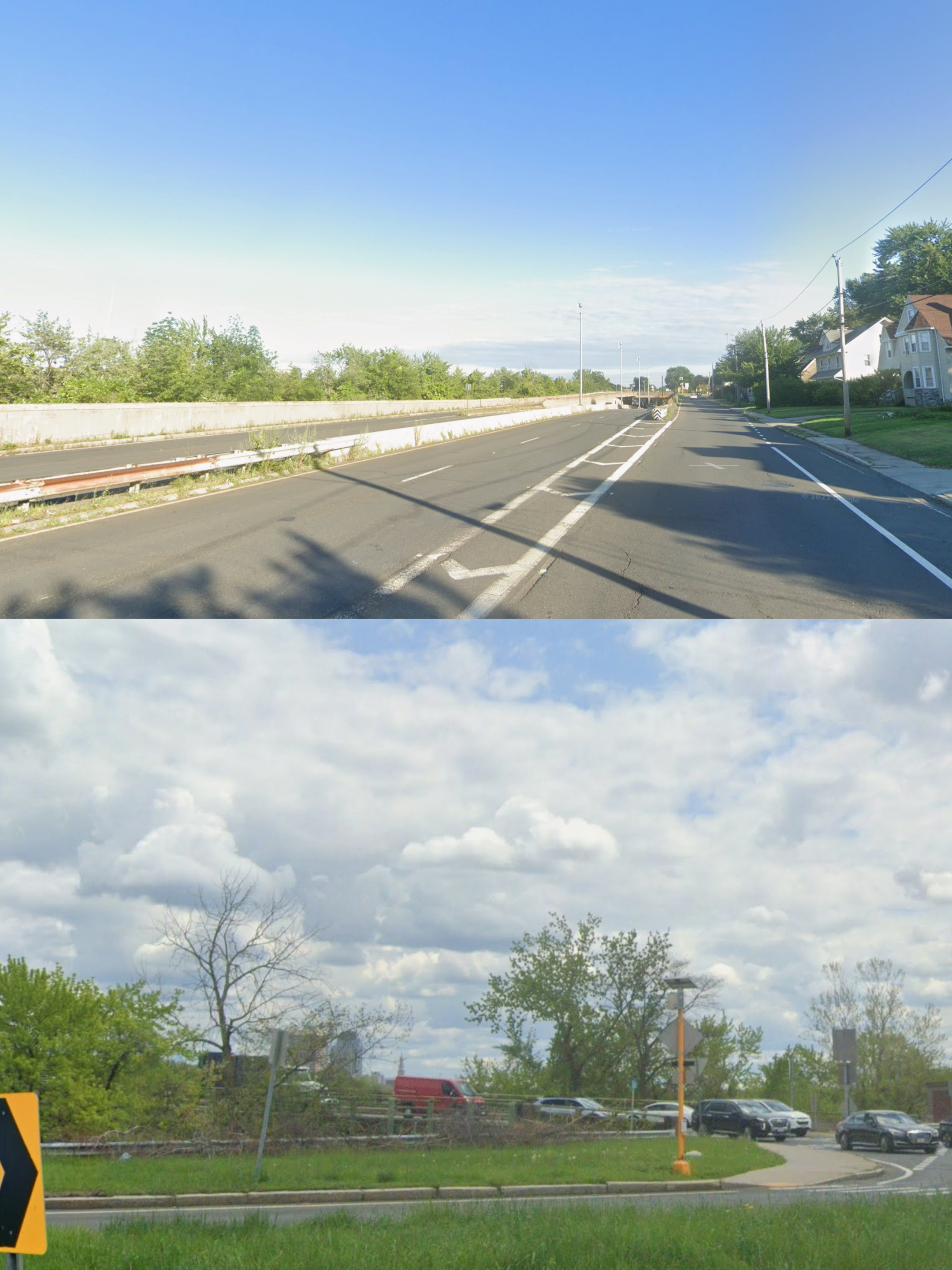
Similar views of my prospective of the tornado from US Route 5 southbound and the North End Bridge/Park St. Rotary. Note the gap in the trees where the Springfield skyline sits in the second image.
There was limited dialogue between my mom and myself besides an expletive from her as we pulled off onto the Park Street exit. From our perspective, the ground circulation was another three quarters of a mile past the exit of the tunnel and around the slight right bend. Despite our safe proximity away, the debris and funnel clouds became increasingly apparent. As it kept moving to my left and away from us, it came into line with a gap in the tree belt that lined the Connecticut River. Launching above the treeline was a white mist, water from the river being pulled up and into the tornado. My final visual of the tornado before we rounded the rotary onto Park Street was it sliding behind Tower Square and Monarch Place, the two skyscrapers in downtown Springfield.
With our encounter concluded, I came out of my awe and relished in the moment that I just witnessed a tornado in my hometown. The gravity of the current situation had not yet dawned on me, but was starting to dawn on my mom. Even only a mile from the baseball field, traffic was abnormally gridlocked. Emergency vehicle sirens started to fill the ambient noise as it took 20 minutes to drive a mile. The field, located at the corner of River and Baldwin Streets, was ultimately within the path of the tornado. I pulled out my iPod Touch and started filming the downed trees around the field.
It was around this time the tornado was near peak intensity to my immediate east, devastating the town of Monson and carving a half-mile-wide path through the Brimfield State Forest. Immediately around me at the baseball field were some downed trees and flattened grass, but just past the railyard on Union Street, Angelica Guerrero shielded her 15-year-old daughter in a bathtub as their three-family home collapsed on top of them. Angelica died protecting her daughter. On the next block over on Main Street, Sergey Livchin, 23, was killed when an oak tree came down on his car.
While I was awestruck on Route 5, watching something I fantasized over actually happen in front of me, two people were killed. Two people that were a part of my community.
Obviously, my baseball game was canceled and we headed back home. My house was on the other side of town, miles away from the tornado’s path. Even though it was Game 1 of the Stanley Cup Finals for my Boston Bruins, the game was never put on the TV that night (frankly, it was a snooze of a game with a 1-0 win for Vancouver). Instead, just like the week prior, the Weather Channel became the backing track of the rest of the event. Another storm came through later that evening, dropping some decent-sized hail for the northeast (between quarter to golf-ball). I collected the best stones I could find and placed them in the freezer.
School was canceled for the rest of the week as city officials converted the gymnasium of my Middle School into a temporary shelter for those displaced. We didn’t use that area of the school for the remainder of the year. That first Monday back in school was not at all productive. One of my classmates shared a story of rushing to the bathroom before the roof peeled off of his house. Another spoke of the glass blowing in on their family car as the tornado overtook their vehicle. My PE teacher, Mrs. Smith, had essentially lost her home in Monson. Being the weather nerd of the grade, I broke down how something like this could happen, defining terms like supercell thunderstorm and wall cloud. I also showed off my hailstones that I brought in a cooler. Unfortunately by the end of the day they had all melted.
It was that first school day back that the real nature of the situation really started to set in for me. It was the first time that I felt the human element in the aftermath of destructive tornadoes. Even as a 6th grader, it was now setting in that tornadoes were more than what I was consuming on shows like Storm Chasers or the books I was reading from the library. While incredible acts of nature to witness, they can bring people the worst day of their entire lives. I was looking into the eyes of people that lived that horror. It is a heavy lesson that I’m thankful to have had in those key formative years. The weather was still captivating, but now I witnessed the pain brought to those that had survived it. It was real now.
What took even longer to fully grasp was just how incredible the alignment of circumstances were for me to witness that tornado. Western Massachusetts averages a strong to violent tornado once every 15 to 20 years since reliable records started being kept. Notable previous events include the 1995 Great Barrington F4 and the 1973 West Stockbridge F4. On top of the rarity of just the meteorology aligning over my hometown was my own placement. Had I not had a baseball game that afternoon at that specific field at that specific time. Had my mom not needed to make a quick errand, forcing us to take the route along the river instead of through town. It was all just the absolute perfect alignment of circumstances for me, a weather-obsessed kid, to witness a rare strong tornado in New England from a safe distance that was impactful enough in my own hometown to leave an everlasting impression.
The right place at the right time.
My life’s direction forever-altered.

Composite satellite imagery of the tornado’s scar from Westfield to Charlton, MA.
15 years later, the dominos that fell and continue to fall since then is my own personal butterfly effect. I started following role models in weather throughout my time remaining in Middle School. I dedicated my 8th grade sustainability science project, a homemade wind turbine, to Tim Samaras as it was presented in the week following the El Reno Tornado tragedy. I made the conscious decision to pursue engineering within the context of severe weather, like Ted Fujita, Tim Marshall, and of course, Tim Samaras again. My college campus was impacted by a tornado in 2018, allowing a real-life connection for the school’s grant writers to award me funding for June First’s original engineering research work in studying supercells. Now in the years following college, June First is one of the premiere YouTube channels in the meteorology space on the platform, educating literally millions of people on the science, history, and hazards of severe weather.
Sure, I was a weather-interested kid in 2011, but it wasn’t my only interest. Had I not witnessed that tornado, where would I be now? Would I still be searching for my career-driving purpose? I feel so lucky in many ways because there are plenty of people that get so far into life before finding what fulfills them. Some never find it at all. I consider myself so fortunate to have found mine at such a formative age. Sure, I still don’t have it all figured out. I’m still only five years removed from college graduation, so my career is only just getting started. Even so, the transformative experience of June 1st, 2011 is the rock-solid foundation that everything I’ve completed thus far is built off of.